
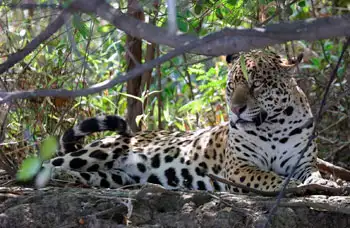
Private Jaguar Photo Safari
Close encounters with the third-largest feline on the planet: wildlife observation and photographic safaris.


Considered the largest tropical wetland and floodplain in the world, the Pantanal lies in the upper Paraguay River basin and covers approximately 150,000 km², most of it in the Brazilian states of Mato Grosso and Mato Grosso do Sul, bordering Bolivia and the Chaco region of Paraguay to the west and southwest. This flat region is regularly flooded during the rainy season from November to April, when rainfall reaches 1,200–1,500 mm per year. In April 1988, 100,000 km² were flooded up to 6.64 m deep, killing thousands of cattle. The floodwaters drain very slowly from north to south through the Paraguay River, a process that can take up to three months.
Although the terrain varies in height by only 80–150 cm, the slightly higher areas become refuges for many animal species during the floods. The Pantanal deserves special attention for its wildlife, which is exceptional on the American continent. The mix of savanna-like grassland, scrubland and various types of forest (evergreen, semi-evergreen, gallery forest, etc.) is one of the reasons for the highest concentration of wildlife on the continent. With around 650 bird species, it is also a paradise for birdwatchers.
Although parts of this species-rich wetland were declared a UNESCO World Heritage Site in 2000, the Pantanal is threatened by wildfires caused by increasingly extreme dry periods, slash-and-burn clearing, agriculture and cattle ranching. Fortunately, sustainable tourism has helped to protect many species, including endangered ones. Local ranchers, for example, stopped hunting jaguars when they saw their potential for tourism, and the once nearly extinct big cat has since successfully recovered. Today, jaguars are "hunted" only by photographers and film crews. During their stay at our fazenda, guests have the unique opportunity to see two species protection projects: for the giant armadillo (Priodontes maximus) and the lowland tapir (Tapirus terrestris).

Close encounters with the third-largest feline on the planet: wildlife observation and photographic safaris.
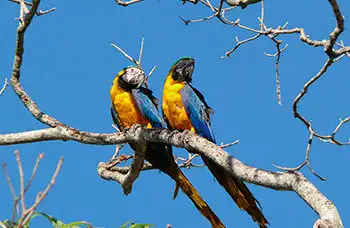
One of the richest concentrations of wildlife in the Americas.
Optional extension to Bonito.